Vibrating Wristbands vs Bed Shakers: Which Alert Fits Your Day

Both deliver alerts through vibration. But a wristband and a bed shaker solve completely different problems at completely different times of day. This guide explains exactly what each device does, when each one works, and why a complete alerting strategy for deaf and hard-of-hearing people almost always needs both.
A vibrating wristband receiver - like the Bellman Watch Receiver - is a daytime device. You wear it on your wrist while awake and moving through the home, and it alerts you to doorbells, smoke alarms, baby monitors, and phone calls with distinct vibration patterns that reach you wherever you are. A bed shaker - like the Bellman Bed Shaker used with the Alarm Clock Receiver - is a nighttime device. It sits under your mattress or pillow and delivers powerful whole-body vibration to rouse you from sleep when hearing aids are out, and wrist-worn devices are charging. They are not alternatives to each other - they are two halves of a complete 24-hour alerting system. Most people with significant hearing loss need both.
Start Here: Why This Is the Wrong Question - and the Right One
People searching for "vibrating wristband vs bed shaker" are usually trying to choose between them. It is an understandable instinct - both are vibration-based alert devices, both are commonly recommended for people with hearing loss, and when you are looking at a product page, it can seem like they are doing the same job in different form factors.
They are not. A vibrating wristband and a bed shaker operate in completely separate windows of daily life, solve completely different alerting problems, and fail in completely different ways when used outside their intended context. Choosing between them is like choosing between a smoke alarm and a door lock - the question itself reveals a misunderstanding of what each one is for.
The more useful question - and the one this guide actually answers - is: what does each device do, in which specific situations does it work reliably, and how do you combine them so that no critical alert is ever missed across the full 24-hour day? That is the frame that leads to the right decision. Whether you are building an alerting system from scratch, filling a gap in an existing one, or evaluating Bellman products for the first time, this guide gives you the complete picture.
What a Vibrating Wristband Receiver Actually Is
The term "vibrating wristband" covers a range of very different products - from smartwatch notification mirrors to purpose-built dedicated alert receivers. Understanding the difference matters, because the technology behind each type determines where it works reliably and where it does not. This guide focuses on dedicated vibrating wristband receivers: devices designed specifically for hearing loss alerting, not adapted from general consumer wearables.
How a dedicated wristband receiver works
A dedicated vibrating wristband receiver like the Bellman Watch Receiver is a wrist-worn alert device that communicates directly with a home alerting hub - in Bellman's case, the Bluetooth Bridge. When any transmitter in the home fires - a doorbell, a smoke alarm, a baby monitor, a telephone - the Bridge receives the RF signal from that transmitter and relays it immediately to the Watch Receiver via Bluetooth. The Watch vibrates with a distinct pattern specific to that alert type and displays a clear icon on screen identifying the source.
No smartphone is required. No internet connection is needed. The Watch Receiver communicates directly with the Bridge over Bluetooth 5, with a range of up to 650 feet in open field - meaning it covers the full footprint of virtually any home, including the backyard, garage, and outbuildings. The entire dependency chain is two links: transmitter to Bridge, Bridge to Watch. That simplicity is a reliability feature, not a limitation.
What makes it a daytime device
The Watch Receiver is designed to be worn on the wrist throughout the waking day. It is comfortable for all-day wear, offers up to one week of battery life per charge, and uses a wristband form factor that travels with you naturally from room to room. Its defining advantage - being worn on your body - is also the condition that defines its appropriate use context. During the day, when you are awake and mobile, the Watch Receiver gives you whole-home coverage with no gaps. At night, when you take it off to charge, that coverage disappears. The Watch Receiver does not solve the nighttime alerting problem - and it is not designed to.
What it covers
Every alert source connected to the Bellman system through a compatible transmitter can reach the Watch Receiver. That includes:
- Doorbell alerts - any visitor press triggers an immediate wrist vibration with a doorbell icon, wherever you are in the home or yard
- Smoke and CO alarm alerts - safety-critical, high-priority vibration pattern for immediate awareness
- Baby monitor alerts - a distinct pattern for infant sound detection, letting you move freely through the house
- Telephone alerts - wrist notification when the landline rings, so you are not anchored to a room with a fixed receiver
- Push button alerts - a family member or caregiver can trigger an attention signal that reaches you on the wrist
Consumer smartwatches - Apple Watch, Samsung Galaxy Watch - can deliver wrist vibrations for incoming calls and messages, and Apple Watch's Sound Recognition feature adds limited environmental sound detection. These are useful supplemental tools. However, they depend on a smartphone being nearby (within Bluetooth range), an internet connection, and app software running reliably. A dedicated wristband receiver like the Bellman Watch Receiver bypasses all of that - it communicates directly with the Bridge, requires no phone proximity, and works during internet outages. For safety-critical home alerts, the dedicated receiver is the correct tool. For a full comparison, see How Smartwatch Alerts Work for People with Hearing Loss.
What a Bed Shaker Actually Is - and Why It Exists
A bed shaker is a vibration pad placed under the mattress or pillow that delivers powerful whole-body tactile alerts when triggered by a compatible receiver. It is not a wearable device. It is not mobile. It does not travel with you from room to room. It is specifically engineered for a single, defined scenario: waking a person from sleep who cannot hear audio alerts and is not wearing any wrist-based alerting device.
The problem it exists to solve
Every person who wears hearing aids or a cochlear implant processor removes those devices at night. The window between removing hearing aids and replacing them in the morning - typically eight hours or more - is the highest-risk alerting gap in any deaf or hard of hearing person's day. During that window, audio alerts are inaudible. A wristband device is typically charging. A smartphone is across the room. Visual flashing lights help if the room is dark enough and if the person is facing them, but they do not reliably wake a person in deep sleep. The bed shaker addresses this gap directly: it delivers vibration through the sleeping surface itself, reaching the person's body regardless of room orientation, light level, or sleep depth.
How it works in the Bellman system
The Bellman Bed Shaker is a wired accessory that connects directly to the Bellman Alarm Clock Receiver. The Alarm Clock Receiver is a bedside unit that receives wireless RF signals from any transmitter in the Bellman system - the same smoke alarm transmitter, doorbell transmitter, and baby monitor transmitter that signal the Watch Receiver during the day. When a transmitter fires at night, the Alarm Clock Receiver activates the bed shaker, its 100 dB alarm, and its flashing lights simultaneously, creating a multi-sensory alert powerful enough to wake most people from deep sleep. The bed shaker produces intense vibration through the mattress - felt throughout the body, not just at the point of contact. For most users, the vibration alone is sufficient to wake them; the sound and light add redundant confirmation.
Where it goes
The bed shaker pad is placed either under the pillow or under the mattress, connected via cable to the Alarm Clock Receiver on the nightstand. Under-pillow placement typically produces stronger vibration felt through the neck, shoulders, and head. Under-mattress placement distributes the vibration across the full body surface. Many users try both and settle on the placement that wakes them most reliably. The pad's anti-slip surface holds it in position throughout the night, and the cable length accommodates standard nightstand positioning without requiring the receiver to be within arm's reach of the bed itself.
The bed shaker does not need to be subtle. It needs to wake you up. Everything else in the alerting system is designed for awareness. The bed shaker is designed for arousal from sleep, and that requires a fundamentally different level of physical stimulus than a wrist vibration.
Bellman & Symfon - Alarm Clock Receiver Design RationaleThe Core Difference: Time of Day, Not Vibration Strength
The most common misunderstanding about these two device categories is that the difference is about vibration intensity - that you choose a bed shaker when you need something stronger than a wristband, or a wristband when you want something more portable than a bed shaker. That framing is incorrect, and it leads people to make the wrong purchasing decision.
The real difference is the time of day. A vibrating wristband receiver is a daytime device for a mobile, waking person. A bed shaker is a nighttime device for a sleeping, stationary person. The two devices are designed for entirely different physical states and entirely different alerting contexts. Neither one is stronger or weaker than the other in any useful sense - they are different tools for different jobs.
You are awake, mobile, and moving through the home. The wristband travels with you. A wrist vibration is enough to get your attention in normal waking activity. The device needs to be discreet and comfortable for hours of continuous wear.
You are asleep, stationary, and not wearing any alert device. A wrist vibration on a charging watch does not reach you. The bed shaker must produce enough physical stimulus to interrupt sleep, a fundamentally higher threshold than daytime awareness.
Daytime coverage is complete. But when you remove the wristband for bed, the alerting system has no overnight layer. A smoke alarm, a fire, a baby cry, or a morning alarm cannot reach you until you wake naturally, which may be hours too late.
Nighttime coverage is complete. But during the day - when you are in the kitchen, the yard, the garage, or a different floor - you have no mobile alerting layer. A fixed-position receiver cannot follow you; a bed shaker in the bedroom cannot alert you in the living room.
The conclusion that follows from this is not subtle: for a person with significant hearing loss, a complete alerting strategy requires both. The wristband covers the daytime mobile window. The bed shaker covers the overnight stationary window. Together, they provide 24-hour coverage. Separately, each one has an eight-to-sixteen-hour gap during which critical safety alerts cannot reach you.
Full Comparison: Wristband Receiver vs Bed Shaker Across Every Scenario
The table below maps every common alerting scenario to the device that handles it reliably. Use it to identify gaps in your current setup and to understand exactly which product addresses each one.
| Scenario | Vibrating Wristband Receiver | Bed Shaker |
|---|---|---|
| Daytime doorbell - you are in the kitchen | Excellent - Watch vibrates on wrist with doorbell icon; no need to be near a fixed receiver | Not applicable - bed shaker is in the bedroom, not the kitchen; does not provide daytime mobile coverage |
| Daytime doorbell - you are in the backyard | Excellent - 650 ft open-field Bluetooth range means the Watch Receiver covers the garden and outbuildings | Not applicable - fixed bedside unit provides no outdoor or cross-room coverage |
| Smoke alarm fires at 2 a.m. - hearing aids removed | Not available - Watch is typically charging; no wrist vibration reaches a sleeping person | Excellent - Alarm Clock Receiver triggers bed shaker + 100 dB alarm + flashing lights; designed specifically for this scenario |
| Baby crying at night - hearing aids out | Not available - wristband not being worn during sleep; watch on charger | Excellent - Baby Monitor Transmitter signals the Alarm Clock Receiver, which triggers the bed shaker; same system as smoke alert |
| Morning alarm - wake from deep sleep | Not practical - watch is charging overnight; even if worn, wrist vibration alone is not designed to wake from deep sleep | Excellent - Alarm Clock Receiver built-in alarm triggers bed shaker at set time; strong enough to wake heavy sleepers reliably |
| Telephone ringing - you are upstairs, phone is downstairs | Excellent - Watch Receiver vibrates with phone icon wherever you are in the home; no fixed receiver needed upstairs | Partial - Alarm Clock Receiver can relay telephone alerts, but only if you are in the bedroom and the unit is within your awareness |
| Smoke alarm - daytime, you are in the garage | Excellent - Watch Receiver vibrates immediately via Bluetooth from Bridge; long range covers detached spaces | Not applicable - bed shaker provides no coverage outside the bedroom regardless of time of day |
| Travel - hotel room, away from home system | Partial - Watch Receiver requires the home Bridge; does not function away from the Bellman system (see Vibio for travel) | Partial - Vibio portable bed shaker provides wireless travel wake-up; connects via Bluetooth app, no Bridge required |
| CO alarm at night - sleeping, hearing aids out | Not available - Watch is charging; no wrist alert during sleep | Excellent - CO Alarm Transmitter signals Alarm Clock Receiver; bed shaker activates alongside 100 dB alarm and color-coded alert light |
| Internet outage - needs to still work | Full function - Watch Receiver uses Bluetooth direct to Bridge; no internet required | Full function - 433 MHz RF to Alarm Clock Receiver; no internet or Wi-Fi required; battery backup keeps Alarm Clock operating during power outages |
The Bellman Watch Receiver: What Daytime Coverage Actually Looks Like
The Bellman Watch Receiver is the wristband receiver that forms the daytime wearable layer of the Bellman alerting system. Understanding its specific capabilities - and its specific requirements - helps you use it correctly and integrate it with the nighttime layer without gaps.
Distinct vibration patterns per alert type
One of the Watch Receiver's most practically important features is that it uses a different vibration pattern for each type of alert. A doorbell alert vibrates differently from a smoke alarm alert, which vibrates differently from a baby monitor alert or a telephone ring. You can identify what triggered the alert from the vibration alone - before you even look at the screen. For someone with hearing loss who is in the middle of a task when an alert fires, the ability to identify the alert type without interrupting what you are doing is a genuine quality-of-life improvement. The Watch also displays a clear icon on screen for each alert type as a redundant visual confirmation.
Up to one week of battery life
The Watch Receiver is designed for extended all-day wear, with up to one week of battery life per charge. This eliminates the daily charging discipline required by consumer smartwatches (which typically need charging every one to two days) and reduces the risk of the watch being dead during a critical alert window because you forgot to charge it. A recommended practice is to charge the Watch overnight - while the bed shaker layer covers nighttime alerts - so it is always at full charge when you put it on in the morning.
Requires the Bellman Bluetooth Bridge
The Watch Receiver does not communicate directly with transmitters. It requires the Bellman Bluetooth Bridge to operate - the Bridge receives RF signals from transmitters and relays them to the Watch via Bluetooth. This means the Watch Receiver is a component in a system, not a standalone device. If you are building a new system, the Bridge is the first component to purchase. The Watch Receiver is then added as the daytime wearable layer. Bundles that include both are available across every alert type: smoke and fire bundles, doorbell bundles, baby monitor bundles, and phone bundles.
Call-for-attention function
The Watch Receiver includes a dedicated call-for-attention button that, when pressed, sends a signal through the Bridge to other Bellman receivers in the home. This turns the Watch into a two-way communication tool in caregiving or family settings - a person wearing the Watch can signal for help or attention from wherever they are in the home, and the signal reaches any connected Bellman receiver. This is an important feature for older adults or anyone who may need to summon a household member quickly.
The Alarm Clock Receiver and Bed Shaker: What Nighttime Coverage Actually Looks Like
The nighttime layer of a complete Bellman alerting system centers on the Alarm Clock Receiver and its connected Bed Shaker. This combination is designed for one purpose: ensuring that safety-critical alerts reach a sleeping person who has removed hearing aids, cochlear implant processors, and any wrist-worn device for the night.
Three simultaneous alert channels
When the Alarm Clock Receiver is triggered - by a smoke alarm transmitter, a doorbell transmitter, a baby monitor transmitter, or its own built-in alarm clock - it activates three alert channels simultaneously: the bed shaker (powerful physical vibration under the mattress or pillow), a 100 dB audible alarm (audible to many people with moderate hearing loss even without hearing aids, and genuinely startling for household members), and bright flashing lights with color-coded LEDs that identify the alert type. This multi-channel approach ensures that even if one channel is insufficient for a particular sleeper - whether due to sleep depth, sleep medication, or other factors - the other two provide redundant arousal.
Color-coded alert identification
Like the Watch Receiver's icons, the Alarm Clock Receiver uses color-coded LED indicators to identify which alert triggered the unit. A smoke alarm has a different LED color than a doorbell, which differs from a baby monitor or telephone alert. This means that when you wake to an alert in the night, you can immediately identify what triggered it - whether to go check on the baby, answer the door, or evacuate the building - without waiting for full cognitive clarity to read a display.
Battery backup for power outage resilience
The Alarm Clock Receiver includes built-in rechargeable battery backup. During a power outage - which is itself a potential fire or safety emergency - the Alarm Clock Receiver continues operating on battery power, maintaining alert functionality at exactly the moment it is most needed. This is a deliberate safety design decision: the nighttime layer of a hearing loss alerting system is not a device that should fail when the grid goes down.
Bed shaker placement: under pillow vs. under mattress
The bed shaker pad can be positioned in two ways, each producing a different physical sensation. Under-pillow placement concentrates vibration through the head, neck, and upper body - for many users, this is more effective at interrupting deep sleep quickly because the vibration is felt in close proximity to the brain. Under-mattress placement distributes vibration across the full body surface - less intense at any single point, but experienced through a larger body area. Most users find one placement significantly more effective than the other; it is worth testing both during the day before relying on a nighttime configuration. The bed shaker pad includes an anti-slip surface that prevents it from migrating during movement, and the connecting cable is long enough to reach the Alarm Clock Receiver on a standard nightstand.
- Smoke and CO alarm activation - safety-critical, highest-priority alert
- Doorbell and push button signals - covers nighttime visitors and caregiving calls
- Baby monitor detection - overnight infant awareness for deaf parents
- Telephone ring alerts - landline calls relay to the Alarm Clock Receiver
- Morning alarm wake-up - built-in clock alarm activates bed shaker at set time
- Full function during internet and power outages - battery backup maintains coverage
Why "Just One" Is Almost Never the Right Answer
It is tempting, when evaluating an alerting system for the first time, to think in terms of the minimum viable solution - the one device that covers the most common scenario. For people with mild hearing loss who primarily need awareness of their phone and doorbell during the day, a wristband receiver alone might seem adequate. For people who primarily need to wake up on time and hear a smoke alarm at night, a bed shaker alone might seem like enough. In practice, both of these minimal configurations have predictable, dangerous gaps.
The wristband-only gap
A household using only a wristband receiver - no bed shaker, no alarm clock - has complete daytime coverage and zero overnight coverage. Every night, from the moment the Watch is placed on the charger, there is no mechanism to alert the occupant to a smoke alarm, a fire, a CO leak, or any other safety event. If a visitor arrives at 6 a.m., there is no alert. If a baby cries at 2 a.m., there is no alert. This gap is not theoretical; it is the exact scenario in which missed safety alerts cause harm.
The bed shaker-only gap
A household using only a bed shaker and Alarm Clock Receiver - no wristband - has complete overnight coverage but no daytime mobile coverage. During the day, alerts are limited to fixed-position receivers in specific rooms. If you are in the kitchen and your doorbell transmitter signals, you receive no alert unless there is a fixed receiver in the kitchen. If you are in the yard, there is no coverage at all. For anyone who moves through their home actively - which is most people - this configuration means regular missed alerts throughout every waking day.
The complete configuration
The correct setup pairs both layers: the Watch Receiver and Bluetooth Bridge for daytime wearable coverage, and the Alarm Clock Receiver with Bed Shaker for overnight coverage. Both layers receive signals from the same transmitters - the same smoke alarm transmitter, doorbell transmitter, and baby monitor transmitter serve both the Watch Receiver during the day and the Alarm Clock Receiver at night. You do not need separate transmitter sets for each layer. The transmitters communicate via RF to all receivers within range; both the Bridge and the Alarm Clock Receiver listen simultaneously. For a full walkthrough of the 24-hour system architecture, see our guide: Daytime vs Nighttime Alerting: Building a 24-Hour System.
Special Use Cases: When the Answer Is Less Straightforward
The daytime/nighttime split covers the vast majority of alerting scenarios, but some situations introduce additional considerations that affect which device combination makes the most sense. Here are the most common ones.
Deaf Parents with Young Children
Baby monitoring is a use case where both layers are genuinely critical. During the day, the Watch Receiver provides whole-home baby monitor coverage - you can move freely through the house while the baby sleeps. At night, with hearing aids out, the bed shaker layer handles baby monitor alerts through the Alarm Clock Receiver. Neither layer alone covers both contexts. The smoke and fire bundle with Alarm Clock, Bridge, and Watch Receiver can be expanded to include a baby monitor transmitter for exactly this combined coverage.
Older Adults Living Alone
For older adults, the overnight coverage provided by the bed shaker layer takes on additional safety importance. Smoke and CO alerts at night are the highest-priority scenario - and for someone living alone, there is no household member to relay an alert that the primary occupant misses. The Alarm Clock Receiver's battery backup is particularly important here, since power outages during storms or other events coincide with higher fire and safety risk. The wristband receiver adds important daytime value for doorbell and phone awareness, reducing isolation and maintaining connected awareness throughout the day.
Frequent Travelers
The home Bellman system - Bridge, Watch Receiver, Alarm Clock Receiver - is designed for fixed-home installation. Travel introduces a different scenario: hotel rooms without Bellman infrastructure, different time zones, and the need for a portable wake-up solution without the home transmitter network. The Bellman Vibio - a wireless, app-controlled portable bed shaker - is designed specifically for this scenario. It stores up to ten alarms locally, vibrates for incoming calls and messages, and does not require the home Bridge. For travel, the Vibio handles the overnight wake-up need; for home use, the fixed Alarm Clock Receiver and Bed Shaker provide the connected safety alerting layer the Vibio cannot replicate.
Couples with Different Hearing Needs
In households where one partner has significant hearing loss and one does not, the alerting system needs to work for the person with hearing loss without disrupting the hearing partner. The Watch Receiver handles this elegantly during the day - it delivers discreet wrist vibrations that do not affect the hearing partner at all. At night, the bed shaker under the mattress will be felt by both partners to some degree, though under-pillow placement concentrates vibration for the individual user. The 100 dB alarm on the Alarm Clock Receiver will wake the hearing partner as well, which many hearing partners consider a feature, not a drawback, for smoke alarm scenarios.
Large Homes or Multi-Story Properties
In larger homes, the placement of the Bluetooth Bridge becomes more important for Watch Receiver coverage. A centrally placed Bridge maximizes Bluetooth range to all areas of the home. For nighttime coverage, the Alarm Clock Receiver communicates via 433 MHz RF rather than Bluetooth, giving it greater wall-penetrating range from transmitters - making it reliable even in large homes where RF coverage is stronger than Bluetooth coverage. Consider placing smoke alarm transmitters on every floor independently, so each one signals both the Bridge and the Alarm Clock Receiver regardless of which floor the event occurs on.
Caregivers and Assisted Living
In caregiving contexts - where one person needs to be alerted when another person needs help - the push-button transmitter covers the call-for-attention use case. During the day, the Watch Receiver alerts the caregiver immediately when the person in their care presses the push button. At night, the same push button signal routes to the Alarm Clock Receiver and bed shaker, waking the caregiver from sleep. The Watch Receiver's call-for-attention button adds a second channel: the caregiver can also signal for attention through the Watch in the reverse direction. This bidirectional alerting capability makes the system practical in family caregiving arrangements.
How to Build the Complete System: Start Here, Expand Later
The most practical approach to building a complete daytime and nighttime alerting system is to start with the alert type that creates the most significant gap in your current coverage - then expand by adding transmitters over time. Every transmitter you add works simultaneously with both the daytime layer (Watch Receiver via Bridge) and the nighttime layer (Alarm Clock Receiver via RF), so each addition improves both windows of coverage at once.
If you are starting from scratch
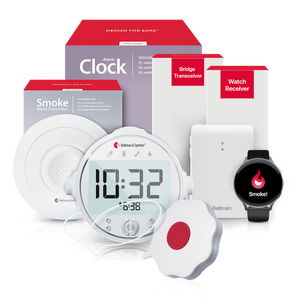
The highest-priority starting point for most households is smoke and CO alarm coverage - the safety scenario where a missed alert has the most serious consequences. The Smoke and Fire Alarm System with Alarm Clock, Bridge, and Watch Receiver provides both layers in a single bundle: the Smoke Alarm Transmitter, the Bluetooth Bridge, the Watch Receiver (daytime), and the Alarm Clock Receiver with Bed Shaker (nighttime). This is the most complete single-purchase starting configuration available in the Bellman range, covering the highest-priority safety alert for both the waking day and overnight.
If you already have a nighttime setup and need the daytime layer
If you have the Alarm Clock Receiver and Bed Shaker already in place but no wristband receiver, adding the Watch Receiver and Bluetooth Bridge extends your existing transmitter coverage to the daytime wearable layer. Your existing smoke alarm transmitter, doorbell transmitter, and baby monitor transmitter will automatically signal the Bridge once it is set up - no re-pairing of transmitters required.
If you already have the daytime layer and need the nighttime layer
If you have the Watch Receiver and Bridge already in place, adding the Alarm Clock Receiver and Bed Shaker closes the overnight gap. The Alarm Clock Receiver receives directly from your existing transmitters via RF - it does not need to communicate with the Bridge. Your transmitters already broadcast on 433 MHz, which the Alarm Clock Receiver receives natively. Place the Alarm Clock Receiver bedside, connect the Bed Shaker, and the overnight layer is operational without changing anything about the daytime setup.
Daytime layer + nighttime layer, confirmed and tested
Work through each item in order - every untested alert is a gap waiting to matter.
- Bluetooth Bridge plugged in, powered on, and centrally placed
- Watch Receiver paired to Bridge - vibration confirmed with test signal
- Watch Receiver charged and worn - daytime layer is live
- Smoke Alarm Transmitter on every floor - tested via smoke alarm test button
- Doorbell Transmitter placed at main entrance - Watch vibration confirmed
- Baby Monitor Transmitter installed if applicable - sensitivity adjusted and tested
- Telephone Transmitter connected if using landline - Watch ring vibration confirmed
- Alarm Clock Receiver bedside - plugged in, time set, battery backup confirmed
- Bed Shaker connected and placed under pillow or mattress
- Alarm Clock Receiver tested via smoke alarm test button - bed shaker activates
- Morning alarm set on Alarm Clock Receiver - bed shaker wake-up confirmed
- Watch Receiver charged nightly while bed shaker covers overnight - rotation established
Quick Decision Guide: Which Device Do You Need?
If you are still working through which device to prioritize, here is the direct, honest answer for each common starting point.
- You miss doorbells and phone calls during the day while moving around the house: You need a vibrating wristband receiver. The Watch Receiver and Bluetooth Bridge cover this completely - wrist alerts anywhere in the home without a fixed receiver in every room.
- You cannot wake reliably to a smoke alarm or morning alarm after removing hearing aids: You need a bed shaker. The Alarm Clock Receiver with Bed Shaker provides the tactile and multi-sensory overnight alert that wrist-based devices cannot deliver during sleep.
- You need both - and you are starting fresh: The Smoke and Fire Alarm System with Alarm Clock, Bridge, and Watch Receiver is the most complete single-purchase starting point, covering the highest-priority safety alert for both day and night.
- You travel frequently and need portable overnight vibration: The Bellman Vibio is the travel-specific bed shaker designed for this - wireless, app-controlled, and fully portable without requiring the home Bridge system.
- You already have one layer and need the other: Add the missing component independently - the Watch Receiver and Bridge for the daytime layer, or the Alarm Clock Receiver and Bed Shaker for the nighttime layer. The transmitters you already have serve both layers automatically once both receivers are in place.
Build your complete daytime and nighttime alerting system.
Browse the full Bellman alerting range - wristband receivers, bed shakers, alarm clock receivers, and complete bundles that cover both layers from day one.
Sources and references: Bellman & Symfon - Bluetooth Watch Receiver BE3330 product specifications including Bluetooth 5, 650 ft open-field range, up to one week battery life, vibration patterns, and icon display (us.bellman.com/products/bluetooth-watch-receiver) · Bellman & Symfon - Alarm Clock Receiver product specifications including 100 dB output, color-coded LED alerts, battery backup, bed shaker output at 2.0–4.0 V DC (us.bellman.com/products/alerting-signaling-device-alarm-clock-receiver) · Bellman & Symfon - Bed Shaker product specifications including anti-slip surface, wired connection, operating voltage (us.bellman.com/products/bed-shaker) · Bellman & Symfon - Bluetooth Bridge Transceiver BE1521 specifications (us.bellman.com/collections/bluetooth-bridge) · Bellman & Symfon - Vibio Portable Bluetooth Bed Shaker specifications including 10-alarm storage, Bluetooth app control, 10-day battery life (us.bellman.com/products/vibio-portable-bluetooth-travel-vibrating-alarm-clock) · Bellman & Symfon - Smoke and Fire Alarm System with Alarm Clock, Bridge, and Watch Receiver bundle specifications (us.bellman.com/products/smoke-fire-alarm-system-with-alarm-clock-bridge-and-watch-receiver) · National Institute on Deafness and Other Communication Disorders (NIDCD) - Assistive Devices for People with Hearing, Voice, Speech, or Language Disorders · Hearing Loss Association of America (HLAA) - Alerting and Signaling Devices overview.
This article is for informational purposes only. Product specifications are subject to change; refer to current product pages at us.bellman.com for the most up-to-date technical details.

Vibrating Wristbands vs Bed Shakers: Which Alert Fits Your Day
This guide breaks down the practical choices, features, and considerations behind this topic. Use it to identify a setup that fits the listener, the environment, and the everyday moments that matter most.
The featured products below are current Bellman options discussed in the article or closely matched to its use case.