Deaf Parenting: How to Stay Safe and Connected at Home With the Right Tech

A practical guide to building a home where deaf and hard-of-hearing parents never miss a baby cry, a doorbell, a smoke alarm, or a call for help - day or night, using technology that works reliably without depending on sound.
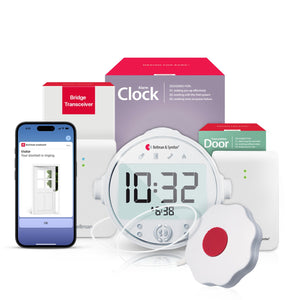
Deaf parents can stay fully aware at home using a connected alert system that sends wrist vibrations for baby cries, doorbells, smoke alarms, and phone calls - keeping the household safe and responsive without relying on sound. The Bellman Bluetooth Bridge serves as the central hub, routing alerts from every sensor in the home to the Bellman Watch Receiver on your wrist and the free Bellman Assistant app on your smartphone - instantly, silently, and reliably.
The Real Challenge of Deaf Parenting at Home
Ask any deaf or hard-of-hearing parent what worries them most, and the answer is rarely abstract. It is specific: will I know the moment my baby needs me? Will I hear the smoke alarm if something goes wrong while the baby is napping and I'm in another room? Will I know someone is at the door without making a noise that wakes the baby? Will I catch a call from the pediatrician while I'm focused on feeding?
These are not hypothetical concerns. They are the practical daily challenges of running a household when sound - the default channel for nearly every home alert, notification, and communication system - is not reliably accessible to you.
The good news is that purpose-built technology has advanced significantly. A well-configured home alert system built around a vibrating wrist receiver and a central Bluetooth Bridge can replace the audio layer entirely - delivering instant, silent, tactile and visual alerts for everything that matters, wherever you are in your home. This guide walks through what that system looks like in practice, room by room and scenario by scenario, so you can build something that actually fits how your household works.
The Core Principle: One Hub, Every Alert, One Wrist
Most commercially available smart home devices - smart doorbells, Wi-Fi baby monitors, connected smoke detectors - were designed for hearing users. Their primary alert mechanism is sound: a chime, an alarm tone, or an audio push notification on a smartphone. Even when these devices offer app notifications as a secondary layer, they route those notifications through the internet, introducing dependency on Wi-Fi uptime, cloud server reliability, and the phone being nearby and not silenced.
For deaf and hard-of-hearing parents, that architecture fails at exactly the moments it matters most - at night, when hearing devices are off; in a busy kitchen, when the phone is across the room; or during an internet outage, when cloud-dependent devices go silent.
The Bellman approach is different by design. The Bellman Bluetooth Bridge is a central hub that receives wireless signals from every alert transmitter in your home and relays them - over local Bluetooth, not the internet - to the Bellman Watch Receiver on your wrist. Every alert, from every room, identified by a distinct icon on the watch face: a baby icon for the nursery, a flame icon for the smoke alarm, a doorbell icon for the front door, a phone icon for an incoming call. One device. One wrist. Total awareness.
The Watch Receiver is always on your wrist - it travels with you as you move through the home, into the yard, or up and down stairs. Smartphone app notifications are valuable as a secondary layer, but phones get put down, silenced, or left in another room. The Watch ensures every alert reaches you wherever you are, whether your phone is with you or not.
The smartphone app is a complement to the Watch, not a replacement. Both channels fire simultaneously for every alert - if you miss the wrist vibration, the app is there as backup, and vice versa.
Baby Monitoring: Staying Aware Without Sound
The most immediate alerting need for deaf parents with a new baby is the nursery. The moment your baby cries or stirs, you need to know - whether you are in the kitchen, in the garden, asleep in bed, or anywhere else in the home. And you need to know without a speaker blasting audio that might startle the baby back awake, or without having to check a phone screen every few minutes.
The Bellman Baby Monitor System with Bluetooth Bridge and Watch Receiver addresses this directly. A sensitive baby transmitter placed in the nursery detects sound above an adjustable threshold and sends a wireless signal to the Bridge the moment it fires. The Bridge relays that signal to your Watch Receiver within seconds - a strong wrist vibration accompanied by a baby icon on the watch face tells you exactly what happened and where.
To understand the full mechanics of how this signal chain works - from detection through transmission to your wrist - see our detailed explainer: How vibrating baby monitors work: a guide for deaf and hard of hearing parents.
Nighttime Baby Monitoring
Overnight alerting deserves its own consideration. When you remove your hearing devices and go to sleep, you are relying entirely on the Watch Receiver's vibration to wake you. The vibration is designed to be strong enough to rouse a sleeping adult - not a gentle nudge, but a purposeful physical sensation against the skin. Most users find it reliably wakes them from normal sleep.
For overnight coverage that also includes a silent morning wake-up, the Bridge + Baby Monitor + Alarm Clock bundle pairs the baby transmitter with a vibrating alarm clock receiver - so both your morning alarm and your overnight baby alerts reach you through the same wrist-based system, with no audible sounds disturbing your partner or the baby.
A baby monitor for a deaf parent is not just a convenience. It is a safety device that needs to function when the internet is down, when the phone is across the room, and when hearing devices are off. Reliability at those moments has to be built in - not assumed.
Bellman & Symfon EditorialThe Silent Household Advantage: More Than Just Baby Alerts
Here is an angle that surprises many new parents in the deaf and hard of hearing community: once you set up a Bellman system for baby monitoring, you have also solved a problem you may not have fully thought through yet - how to receive every other household alert without making noise that wakes the baby.
Think about what a typical alert sounds like in a home with a new baby. A doorbell chime. A phone ring. A smoke alarm. These sounds do not only alert you - they also alert your baby, often at exactly the wrong moment. For hearing parents, this is an inconvenience. For deaf parents, it presents a genuine paradox: the audible systems designed to alert you are the same systems that regularly disturb your baby's sleep.
The Bellman system dissolves this paradox entirely. When every household alert is routed through the Bluetooth Bridge to your Watch Receiver, your home becomes measurably quieter. The doorbell no longer chimes through the house - you feel it on your wrist. The phone no longer rings - you see the phone icon on your watch face. A family member who wants to get your attention presses a push button instead of calling out - and you feel a gentle vibration, while the baby sleeps undisturbed.
Silent Doorbell Alerts
Connect a doorbell transmitter to the same Bridge. When someone rings the bell, your Watch vibrates with a doorbell icon - no chime sounds through the house, no baby wakes up. You go to the door; nobody is disturbed. Explore the full Bellman doorbell alert system for deaf parents.
Push Button - Silent Household Communication
A push button transmitter on the same Bridge lets a co-parent, family member, or caregiver signal you silently - no calling across rooms, no doors slamming, no noise. A push-button icon appears on your watch. Clean, quiet, immediate.
Phone Call Alerts - No Ring Needed
When your mobile phone receives a call, the Bridge detects it and sends a phone icon alert to your Watch Receiver. Your phone does not need to ring audibly. The baby is undisturbed, and you still catch every call from the pediatrician, from family, or from anyone else who matters.
Smoke and CO Alerts - Every Hour
A smoke and CO transmitter on the same Bridge ensures fire and carbon monoxide emergencies trigger an immediate, distinct wrist alert - a flame icon and urgent vibration - day or night, whether you are asleep, feeding the baby, or anywhere else in the home. This is not optional coverage.
This is what makes the Bellman system genuinely different from a standard baby monitor: it is a whole-home awareness platform. The baby monitor is the starting point. The silent household - where every alert reaches you on your wrist instead of through your walls - is the outcome. For a deeper look at everything the system enables beyond baby monitoring, see: Baby monitor for deaf and hard of hearing is more than a baby monitor.
Smoke, Fire, and CO Alerts: Round-the-Clock Safety for Deaf Parents
Of all the home safety alerts, smoke and carbon monoxide detection demands the most rigorous approach. A delayed response to a fire alert is not a missed visitor or a missed call - it is a life-safety issue. For deaf parents, especially those sleeping without hearing devices, standard smoke alarms are simply not an adequate safety mechanism on their own.
A Bellman smoke and CO transmitter placed near your existing smoke alarm detects the alarm's sound and immediately sends a signal to the Bridge. The Bridge relays that signal to your Watch Receiver - a flame icon and an urgent, distinct vibration pattern that is intentionally different from every other alert in the system, so you recognise it instantly even when woken from deep sleep.
Daytime Smoke Coverage
During the day, your Watch Receiver delivers the smoke alert to your wrist wherever you are in the home. Because the Bridge-to-Watch pathway is Bluetooth-based and does not depend on the internet, the alert fires whether your Wi-Fi is working or not. You do not need to be watching your phone. You do not need to be in a specific room. The Watch is with you.
Nighttime Smoke Coverage
Overnight, when you are asleep and hearing devices are removed, the Watch Receiver's vibration is the primary waking mechanism. For households that want an additional layer - particularly in homes with children, where the stakes of a missed nighttime alert are highest - the Bridge + Smoke/CO + Alarm Clock bundle pairs the smoke transmitter with an Alarm Clock receiver that delivers flashing lights and a bed shaker. The Watch covers daytime wrist alerts; the Alarm Clock covers overnight bed-level alerts. Both are connected to the same Bridge.
- Smoke transmitter positioned near existing smoke alarm
- Watch Receiver worn to bed - vibration wakes you without hearing devices
- Alarm Clock with bed shaker connected for additional overnight alert layer
- CO transmitter on same Bridge - same wrist alert pathway
- Baby transmitter tested from nursery before first overnight use
- All transmitters tested with hearing devices removed to confirm vibration strength
Building a Routine: How the System Works Through a Full Day
One of the most practical ways to understand what a Bellman alerting system actually delivers is to walk through a typical day as a deaf parent - the specific moments where sound-based systems fall short and where wrist-based alerts change the experience entirely.
Morning
You wake not to an audible alarm but to the vibration of your Watch Receiver - the alarm clock transmitter, connected to the same Bridge, triggered the alert silently. Your partner and baby are undisturbed. You get up, start the day.
While making breakfast, the baby monitor transmitter in the nursery fires - a small sound from the crib. Your Watch vibrates. Baby icon. You check on the baby before a full cry develops. Back to breakfast.
Mid-Morning
A delivery driver rings the front doorbell. Your Watch vibrates: doorbell icon. No chime has sounded through the house. The baby, down for a nap, continues sleeping. You answer the door at your own pace.
Your co-parent, in the garden, wants to ask you something. Instead of calling through the house and risking waking the baby, they press the push button transmitter in the kitchen. Your Watch vibrates: push button icon. You step outside. Baby stays asleep.
Afternoon
You are in the garage. Your phone rings - a call from the pediatrician's office. The Bridge detects the incoming call and sends a phone icon alert to your Watch. You feel it on your wrist, step inside, and take the call before it goes to voicemail.
Evening
You are watching TV with captions on, hearing devices out. The baby stirs in the nursery. Watch vibrates. Baby icon. You were not looking at your phone. You were not near any lamp flasher. The Watch caught it regardless.
Night
Hearing devices off, Watch Receiver on your wrist. The baby cries at 2 a.m. The Watch vibrates - strong, purposeful, waking. You are up in seconds. No audible alarm has sounded. Your partner sleeps on.
Notice what this day has in common across every scenario: the Watch Receiver is always the first channel of awareness. Not the phone. Not a lamp flasher. Not checking a camera screen. The wrist alert is the constant - the one notification layer that travels with you through every room, every activity, and every part of the night. The smartphone app is always there as a simultaneous backup. But the Watch is the anchor.
Why Internet-Independent Alerting Matters for Deaf Parents
Smart home devices - including many modern baby monitors, smart doorbells, and connected smoke detectors - route their alerts through the internet. The signal path looks like this: sensor detects event → transmits to home router → router sends to manufacturer's cloud server → cloud pushes notification to your smartphone app. Every link in that chain is a potential failure point.
For a hearing parent, a failed cloud notification is a minor inconvenience - they may still hear the actual alarm or doorbell. For a deaf parent relying on the app notification as their primary alert channel, that failure is a genuine safety gap. A router reboot, an ISP outage, a manufacturer server hiccup, or a phone with background notifications throttled by the operating system can all silently break the alert chain at the worst possible moment.
Alert routes through home Wi-Fi → manufacturer's cloud server → smartphone app. Fails during internet outages, server disruptions, router reboots, or app notification delays. Not designed for deaf users as a primary safety channel.
Alert routes from transmitter → Bridge → Watch Receiver via local Bluetooth. No internet required. No cloud dependency. No subscription. Works during Wi-Fi outages. The app is a simultaneous secondary channel, not the only one.
The Bellman Bridge's core alert pathway - transmitter to Bridge to Watch Receiver - is entirely Bluetooth-based and requires no internet connection after initial setup. For a detailed breakdown of why this matters and how the two architectures compare, see our full guide: Baby monitor without Wi-Fi for deaf parents: why offline is safer.
Coverage Across Your Whole Home: Range and Multi-Room Setups
Whole-home coverage is not just a feature - it is the core requirement. A baby monitor that works well from the bedroom but drops out in the kitchen, the garden, or the garage is not a whole-home solution. It is a partial solution with a gap exactly where you might need it most.
The Bellman Bridge architecture is designed around this need. The Bridge-to-Watch Receiver Bluetooth range is up to 650 feet in open field - enough to cover most large homes, multi-story houses, and adjacent outdoor areas. The transmitters themselves use 433 MHz radio frequency, which passes through walls and floors without requiring line-of-sight placement.
For families with twins, children in separate rooms, or multiple floors, a single Bridge supports multiple transmitters simultaneously. Each transmitter sends its own distinct icon alert to the Watch - so you know whether the alert is coming from Room 1 or Room 2, from the front doorbell or the smoke alarm, without any ambiguity. To build out a multi-room or multi-child setup, see our detailed guide: Baby monitor for twins and large families: multi-room alert setup guide. And for a full discussion of range requirements, see: Baby monitor range: how to choose one that covers your whole home.
How to Build the Right Setup for Your Household
The right configuration depends on your home, your family structure, and your specific needs. The Bellman system is modular - you start with what matters most and expand over time without replacing any existing components. Here is a practical framework for building your setup.
Start With the Core
The Bellman Baby Monitor System with Bluetooth Bridge and Watch Receiver is the foundation. It gives you the baby transmitter, the Bridge, and the Watch - the three components that power every other alert you add later. Once this is in place, every additional transmitter you add plugs into the same Bridge and reaches the same Watch. There is nothing to re-pair, reconfigure, or replace.
Add Silent Overnight Coverage
For overnight baby monitoring paired with a silent wake-up alarm, add the Alarm Clock receiver. The Bridge + Baby Monitor + Alarm Clock bundle covers both needs through the same Bridge. The Watch handles daytime wrist alerts; the Alarm Clock handles overnight bed-level alerts with a built-in bed shaker.
Add Whole-Home Safety
Once your baby monitoring is in place, add a smoke and CO transmitter to the same Bridge. The Bridge + Smoke/CO + Alarm Clock bundle is a strong foundation for households that want overnight fire safety coverage alongside baby monitoring - both alert types routed through the same wrist receiver and the same app.
Add Silent Household Communication
For households with a co-parent, family member, or caregiver who needs a quiet way to get your attention, add a push button transmitter. The Bridge + Push Button + Alarm Clock bundle combines silent household signaling with overnight alert coverage. No more calling across rooms. No more doors banging. Just a wrist vibration when someone needs you.
Build your full coverage layer by layer
Each item below can be added to one Bridge without replacing anything already in place.
- Baby Monitor Transmitter - nursery coverage
- Bluetooth Bridge - central hub, plugged in centrally
- Watch Receiver - worn all day, to bed at night
- Smoke / CO Transmitter - fire and CO safety day & night
- Doorbell Transmitter - no chime, no woken baby
- Push Button Transmitter - silent household signaling
- Alarm Clock with bed shaker - overnight wake-up layer
- Bellman Assistant App - simultaneous secondary alerts on phone
- All transmitters tested with hearing devices removed
- Watch charged daily for uninterrupted overnight coverage
Getting Started: What Setup Actually Takes
One concern that comes up regularly is whether purpose-built alerting systems are complicated to install and configure. The honest answer is that the Bellman system is specifically designed not to be. There is no drilling, no wiring, no network programming, and no professional setup fee. Every component either plugs into a wall outlet or clips onto a surface with a mounting bracket. Most users are fully operational in under ten minutes.
- Plug in the Bridge in a central location - a hallway, living room, or central bedroom works well. Connect it to your home Wi-Fi through the Bellman app for smartphone notifications (the Watch Receiver does not require Wi-Fi).
- Pair the Watch Receiver to the Bridge - a simple button sequence takes about a minute. Once paired, the Watch receives every alert the Bridge passes on.
- Place transmitters near each device you want to monitor. Battery-powered and wireless - no electrician, no tools.
- Test every transmitter individually - press the test button or trigger the monitored event and confirm the Watch vibrates with the correct icon.
- Add the Bellman Assistant app on iOS or Android for simultaneous smartphone notifications as a secondary alert layer.
The system is designed to be non-technical and accessible. If you can charge a phone and connect to Wi-Fi, you can configure a Bellman system. Sensitivity settings on the baby transmitter are adjustable via a simple dial - useful for tuning out background noise while keeping the threshold low enough to catch early fussing before it becomes a full cry.
Deaf Parenting Alert Systems: How the Options Compare
| Consideration | Standard Smart Baby Monitor | Bellman Bluetooth Bridge System |
|---|---|---|
| Primary alert for deaf users | Audio speaker + app notification - requires internet and phone nearby | Wrist vibration via Watch Receiver - always on your wrist, no internet required |
| Works during internet outage | No - app notifications depend on cloud connectivity | Yes - Bridge to Watch Receiver is local Bluetooth, not internet-dependent |
| Covers doorbell silently | No - requires separate smart doorbell device and app | Yes - doorbell transmitter on same Bridge, same Watch alert |
| Covers smoke alarm | Not typically - requires additional connected smoke detector | Yes - smoke transmitter on same Bridge, distinct flame icon alert |
| Silent household - no sounds that wake baby | No - doorbell, phone, and other alerts still audible | Yes - all alerts routed to wrist silently; home stays quiet |
| Subscription required | Often yes - cloud features require ongoing fees | No - no subscription, no account fees for core alerting |
| Designed for deaf & hard of hearing users | No - audio-first design, accessibility is an add-on | Yes - vibrating wrist alert is the primary design intent |
Practical Tips for Deaf Parents Using a Home Alert System
Technology is only part of the picture. How you integrate it into your daily routine determines how effective it actually is. These are the habits and practices that deaf and hard of hearing parents using the Bellman system have found most useful.
- Wear the Watch Receiver consistently. The most common reason alerts are missed is that the Watch is on the charger or the bedside table when an event fires. Charge it during a fixed window - a meal, for example - and keep it on your wrist the rest of the time, including during sleep.
- Test the full system periodically. Press the test button on each transmitter every few weeks to confirm the signal chain is intact. Batteries in transmitters should be replaced proactively; a weak battery is a common cause of missed alerts.
- Position the baby transmitter carefully. Place it within 3–5 feet of where the baby sleeps, not directly inside the crib. Adjust the sensitivity dial so it catches early fussing without triggering on normal room sounds like an air conditioner or fan.
- Place the Bridge centrally. The Bridge should be equidistant from the areas it needs to cover - not in a corner, not in the basement, not tucked behind a router. A hallway or central living area typically gives the best coverage symmetry.
- Add transmitters before you need them. If you are expecting a second child, add a second baby transmitter before the arrival. If you are moving to a new home, test coverage in the new layout before relying on it. The system is easy to expand; the time to expand it is not in the middle of a crisis.
- Use the push button during nap time. Train family members and caregivers to use the push button instead of calling across rooms during the baby's sleep windows. This one habit change significantly reduces the number of sounds that disrupt naps - which benefits everyone in the household.
The silent household is not just about your needs as a deaf parent. When every alert reaches you on your wrist instead of through a speaker, your home is genuinely quieter. That is better for your baby, better for your partner, and better for everyone who lives there.
Bellman & Symfon EditorialSleep, Parenting, and Hearing Loss: Making It Work
Sleep is the most vulnerable time for any parent - the period when you are least able to monitor your environment and most dependent on your alert system working reliably. For deaf parents, that vulnerability is compounded by the removal of hearing devices and the near-total reliance on tactile and visual alerts.
The Watch Receiver is designed to be worn during sleep. It is comfortable, lightweight, and produces a vibration strong enough to serve as a genuine wake-up trigger - not just a nudge, but a physical sensation capable of interrupting normal sleep. The overnight baby monitoring use case is one the product was explicitly built for.
For parents who want additional assurance - particularly in homes with multiple children, or for parents who sleep very deeply - adding the Alarm Clock receiver to the Bridge gives a second, room-level alert layer: flashing lights and a bed shaker that activates simultaneously with the Watch vibration. This redundancy is the same principle used in professional assistive listening environments where a single-point failure is not acceptable.
For a comprehensive look at overnight alerting strategies, sleep routines, and practical tools for parents with hearing loss, see: Sleep and parenting with hearing loss: practical tips and alert tools that help.
Build your whole-home alert system - designed for deaf parents.
Explore the Bellman Baby Monitor system and the full range of Bluetooth Bridge accessories. Baby alerts, doorbell, smoke, push button, and alarm clock - all on your wrist, all on one system.
Sources and references: National Institute on Deafness and Other Communication Disorders (NIDCD) - Quick Statistics About Hearing; Noise-Induced Hearing Loss · World Health Organization (WHO) - Deafness and Hearing Loss Fact Sheet (2026) · Centers for Disease Control and Prevention (CDC) - Hearing Loss in Adults; Infant Safe Sleep Guidelines · National Association of the Deaf (NAD) - Parenting and Assistive Technology Resources · Gallaudet University Research Institute - Deaf Parenting Survey Data · Hearing Loss Association of America (HLAA) - Assistive Technology and Home Safety Resources · American Academy of Pediatrics (AAP) - Safe Sleep Recommendations · Bellman & Symfon - Bluetooth Bridge Transceiver BE1521 product specifications, Watch Receiver BE3330 specifications, Baby Monitor Transmitter specifications, Smoke Alarm Transmitter specifications (us.bellman.com) · Consumer Product Safety Commission (CPSC) - Smoke and CO Detector Guidance.
This article is for informational purposes only and does not constitute medical, safety, or legal advice. For personalised hearing health guidance, consult a licensed audiologist or healthcare provider.

Deaf Parenting: How to Stay Safe and Connected at Home With the Right Tech
This guide breaks down the practical choices, features, and considerations behind this topic. Use it to identify a setup that fits the listener, the environment, and the everyday moments that matter most.
The featured products below are current Bellman options discussed in the article or closely matched to its use case.